
What you'll find in this article
Without beating around the bush, website speed is today one of the most decisive factors – both for SEO and for conversions. We have also written about this topic on LinkedIn.
That’s why it’s worth taking care of: investing in it, yes, but also testing it with a certain regularity. Because it can make the difference between a site in first position on Google and one relegated to the bottom of the page, or be an extra push to buy your products already in the cart.
And no, you don’t need to become a developer to tell whether your site’s performance needs a second look: all it takes is five minutes and the right tool – a free one, at that.
Here’s what we’ll cover in this article.
Site speed is (almost) the only thing that matters
It’s a harsh, sad reality. You can have the most beautiful site in history, but if it takes more than five seconds to load, your visitor is long gone – probably to the competitor who thought about performance too, and not just aesthetics.
Google (for example) has known this for years, and in fact it has stopped treating speed as a technical detail reserved for developers and has instead made it a full-fledged ranking factor.
But it’s a ‘problem’ that doesn’t only concern search engine rankings. A slow site loses users before they even get to read a single line of what you’ve written. And, as a consequence, it loses conversions before anyone has even seen your product or service.
Site speed, in short, is one of those rare cases where working on the technical side improves rankings, user experience, and… revenue all at once.
And it’s not just our impression; the numbers confirm it. The BBC, for example, measured that it loses an additional 10% of its users for every extra second of page load time. Google and Deloitte, in a joint study called Milliseconds Make Millions, analyzed 30 million sessions across 37 international brands and found that an improvement of just a tenth of a second in loading time is enough to increase conversions by 8.4% in retail and 10.1% in travel.
The good news in all this, though, is that speed is something you can optimize right away, and it delivers results right away – unlike a change of content strategy, which takes longer to produce a result, especially when it comes to SEO.
For SEO, Core Web Vitals are central
Core Web Vitals are the metrics Google uses to measure the real experience of people browsing your site. When it comes to search engine rankings (and therefore Google), this is also where you need to start.
What do these “vitals” indicate, that is, the “vital signs” for a site’s performance? Essentially three things: how fast it displays content, how quickly it responds to interactions, and how visually stable it is while loading.
In practice, they measure three concrete aspects of the browsing experience. Three factors that effectively determine whether a user perceives your site as solid and reliable, or as something to close quickly.
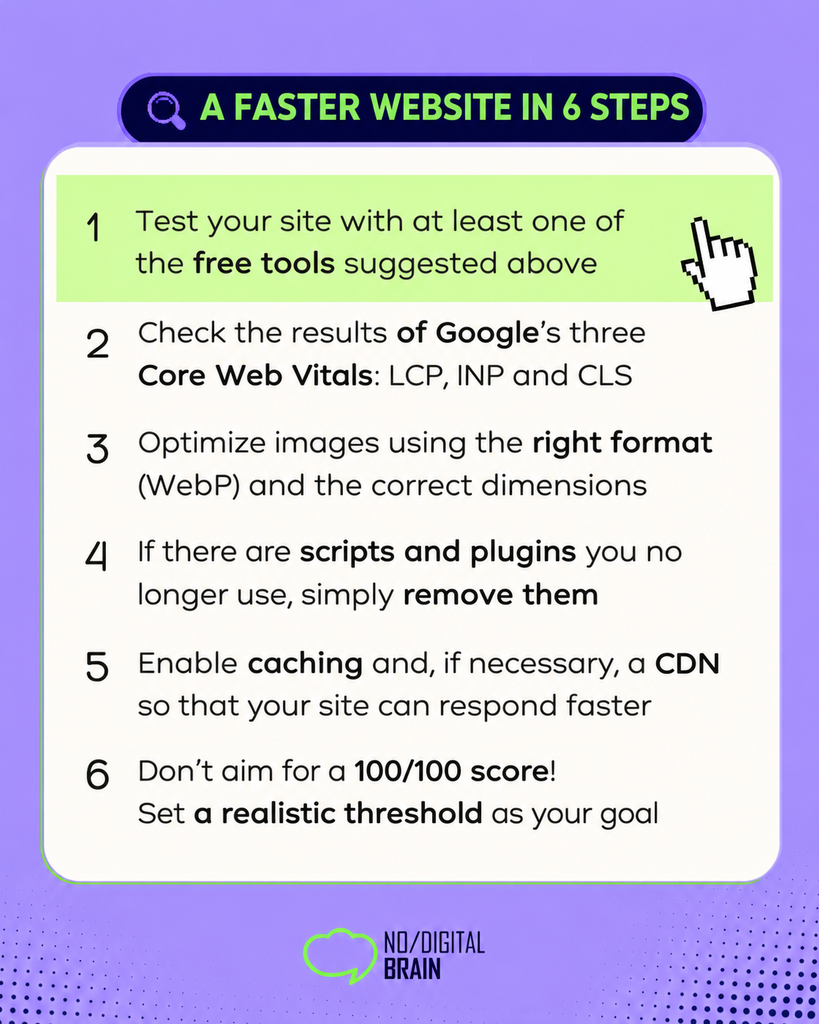
For the site speed test, use these:
Now, let’s suppose your site isn’t performing as you’d hoped. Let’s also suppose, though, that you don’t yet have anything concrete in hand, just a simple impression of your own. What can you do?
Here it is: there are plenty of possibilities. And above all, the web is full of free tools that can give you a more accurate picture of your site’s performance. With the data in hand, you can decide whether or not it’s worth choosing a web agency to optimize your site.
The ones you’ll find below are the ones we use (and recommend) most often, each with a different strength depending on what you need to know. We’re talking about:
- PageSpeed Insights
- GTmetrix
- Pingdom
- Lighthouse
- WebPageTest
But stick around until the end. Because there’s one last free tool that is the most complete of all. And it’s offered directly by No Digital Brain.
- PageSpeed Insights
PageSpeed Insights is Google’s tool, and it’s also the most immediate one on the list: you paste the URL, wait a few seconds and get a score from 0 to 100 for both mobile and desktop. On top of that, PageSpeed Insights also shows you the breakdown of the Core Web Vitals as well as a list of technical suggestions, ready to be passed on to whoever handles your site’s development.
- GTmetrix
If PageSpeed Insights tells you how slow your site is, GTmetrix helps you understand why. Besides the score, it generates a complete loading waterfall: a kind of X-ray that lists every single resource loaded and how long it takes. That way you can pinpoint exactly whether the culprit is a font, a third-party script, or an image that’s too heavy.
- Pingdom
The distinctive feature of Pingdom is the ability to choose where to test your site from: a server in the United States, in Asia, in Europe. A far from superfluous feature if your audience isn’t all concentrated in Italy, because latency varies quite a bit depending on the physical distance between user and server. Useful even just to understand whether you’re really serving every slice of your traffic well.
- Lighthouse
Lighthouse is built right into Chrome’s developer tools, so you don’t even have to switch tabs: just open the panel and run the analysis. It uses the same engine as PageSpeed Insights, but with a few extra configuration options (for example, you can simulate slower connections). Handy if you want quick feedback while you’re already working on the site.
- WebPageTest
Last but not least, WebPageTest, which is the most technical on the list, designed for those who really want to dig deep: it allows advanced tests on different devices, browsers and connection types, with a level of detail that the other tools don’t offer. Admittedly it’s not the easiest to read at a glance, but if you’re looking for precise answers (and not just a score), it’s the right tool.
Why not choose a complete free analysis?
The most complete alternative is offered by No Digital Brain – in other words, we offer it to you. Because at the end of the day a score, however accurate, is still just a number: it tells you how your site is performing, not necessarily what to do about it.
That’s why we came up with a free service that’s different from the tools we’ve seen so far. We’re talking about the SMART Analysis. It’s not a report automatically generated by software, but an analysis done by people, which looks beyond speed – design, SEO, GDPR compliance and, if you run an e-commerce site, the aspects related to online selling as well.
All of it delivered by email within three days, with easy-to-read indicators and no obligation: and if you’d rather fix the issues yourself, the report is still yours to keep.
Request your free SMART Analysis
Aiming for 100/100? It’s just a myth, forget it
Now, though, let’s get one thing out of the way. We’ve given you the tools, okay; but we want one thing to be clear: the perfect score – 100/100 on PageSpeed – seems to have become a kind of collective obsession, but in practice it can’t (and shouldn’t) be your final goal.
Keep in mind that a site with plugins, tracking, dynamic content and various integrations (that is, a real site, not a textbook static landing page) will rarely reach a full score. And that’s fine!
What really matters is staying within the good thresholds of the Core Web Vitals, and continuing to improve from there. In short, chasing a number risks making you waste time on marginal optimizations and keeps you from focusing on what really moves the needle.
In fact, if someone promises you a guaranteed 100/100, that’s the right time to ask a few more questions about how they intend to achieve it. Often that kind of score is reached by disabling features the site needs (like tracking, maps, videos, integrations with other tools). As you can imagine, a realistic score is better than a barely functional site that hits 100%.
Did you “fail” the speed test? Let’s talk about it!
Did you test your site and the score made you turn up your nose? No problem, it’s not a life sentence! Almost all sites have room for improvement, and in most cases targeted interventions and a small investment are enough.
Tell us what came out of the test, get in touch through this form, let’s talk.

Would you like a standalone website?
Contact us to design a customized plan, with no middlemen or sales filters.
Contact us